Diamond Shoals
The Robot Who Looked Like MeDiamond Shoals is an Atlantic location off Hatteras whose postwar transformation links distant environmental contamination to both ecological upheaval and a new food supply. The waters become the setting for the emergence of goo: a changing organism that first appears dangerous and ultimately helps save a hungry world.
Setting and Location
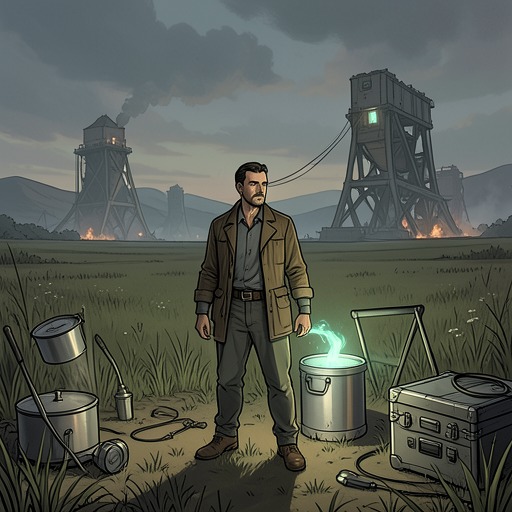
The narrative places Diamond Shoals off the coast of Hatteras, fifty miles out into the Atlantic and at 35 degrees latitude, 75 degrees west longitude. It also locates the area about two miles from TexasTower and within the goo fields, giving the Shoals a precise position in a larger altered seascape.
Pollution and Ecological Transformation
The change begins with contamination left by the Third World War. Westerly winds carry radioactive and biological pollution across North America and out over the Atlantic. Fallout off the Carolinas combines with sunlight and rain, affecting the plankton-rich waters of Diamond Shoals. The account ties this chain of accumulated pollution to the mutation of the local marine environment rather than presenting the change as an isolated anomaly.
Ten years after the war ends, the plankton has become something else: goo, a name given to it by Outer Banks fishermen. Diamond Shoals is described as a cauldron of creation. The goo spreads and adapts, alongside other striking changes in marine life, including deformed exoskeletal fish, new dog-shark species, and a many-armed squid that later disappears. The other forms prove temporary; the goo remains.
From Threat to Food Supply
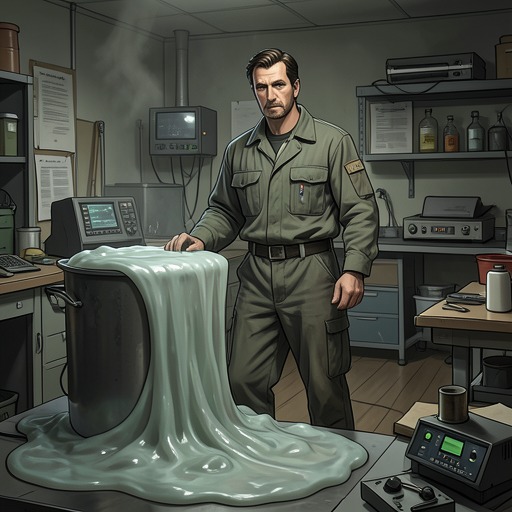
Experiments reveal that the goo, when killed, can be converted into artificial nourishment. It contains proteins, vitamins, amino acids, carbohydrates, and trace elements, and can be dehydrated and packaged as an economically rewarding food. When prepared with water, it can be cooked in many ways; its flavor varies with the patented processing system used, without a characteristic taste of its own. What had seemed an unstoppable threat to life at sea—and perhaps beyond it—becomes a source of food during a global crisis.
The living goo is described as an unstable, apparently unintelligent mass with an urge toward form. It repeatedly organizes itself into rudimentary plant and animal shapes, none viable, as if moving toward an as-yet-unknown state. The Companies’ researchers hope it never discovers what it wants to become. That unresolved possibility leaves the Shoals’ ecological transformation open-ended: the same substance that sustains human survival remains capable of further change.